
Thought Leadership
Reflections on SEND, schools and the spaces in between

by Imran Kassim
Director, Architecture
I had the privilege of joining a panel at this year's Education Estates SEND Conference. The conversation felt timely, honest and, given what the government announced just days later, genuinely significant.
Chaired by Christopher Leese, Technical Director at TG Escapes, I spoke alongside Dr Anita Devi from RYAN Education Academy, SEND Leadership and Strategy and Sue Jagger, Head of English at St Paul’s Catholic School.
We were there to explore a deceptively simple question: what does a well-designed school environment actually do for a child with special educational needs and disabilities (SEND)? Not just practically, in terms of ramps and sensory rooms, but at a much deeper level. How does the space a child walks into every morning tell them something about who they are, how much they matter, and whether they belong?
That question sits at the heart of everything we do at AHR when we work on inclusive education environments. And the answers, I believe, are more urgent now than ever.
Space as a silent teacher
One of the most powerful ideas we explored during the panel was the notion of the learning environment as a ‘silent teacher’. Buildings communicate. Whether we intend them to or not, they send messages - about expectations, about dignity, about whose needs have been thought about and whose have been bolted on as an afterthought.
When a child with SEND arrives at a school where the SEND provision is tucked away at the back, accessed via a separate entrance, reached through a maze of corridors, the building is already telling that child something. It is saying: you are different and difference is something to be hidden.
Good design says the opposite. It signals belonging. It offers appropriate agency and spaces that give children choices about how they regulate, how they move, how they learn. It normalises growth by creating environments that flex with children’s needs, rather than fixing them in place.
This isn’t abstract theory. We see it in practice. At Pear Tree High School in Cheadle Hulme (a specialist secondary school we designed with the Prospere Learning Trust for students aged 11–19 with Profound and Multiple Learning Difficulties (PMLD), Severe Learning Difficulties (SLD) and Autism Spectrum Conditions (ASC)) every design decision was made in service of one idea: that these young people deserve an environment that takes them seriously.


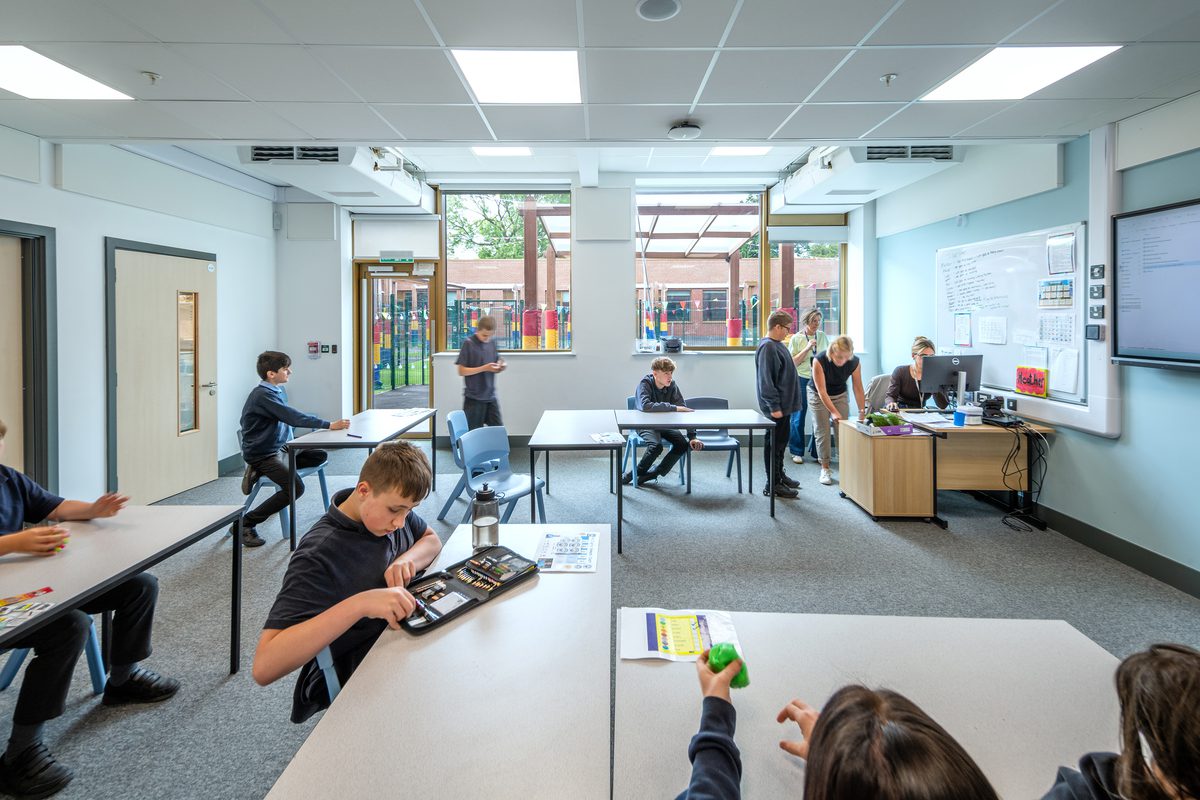
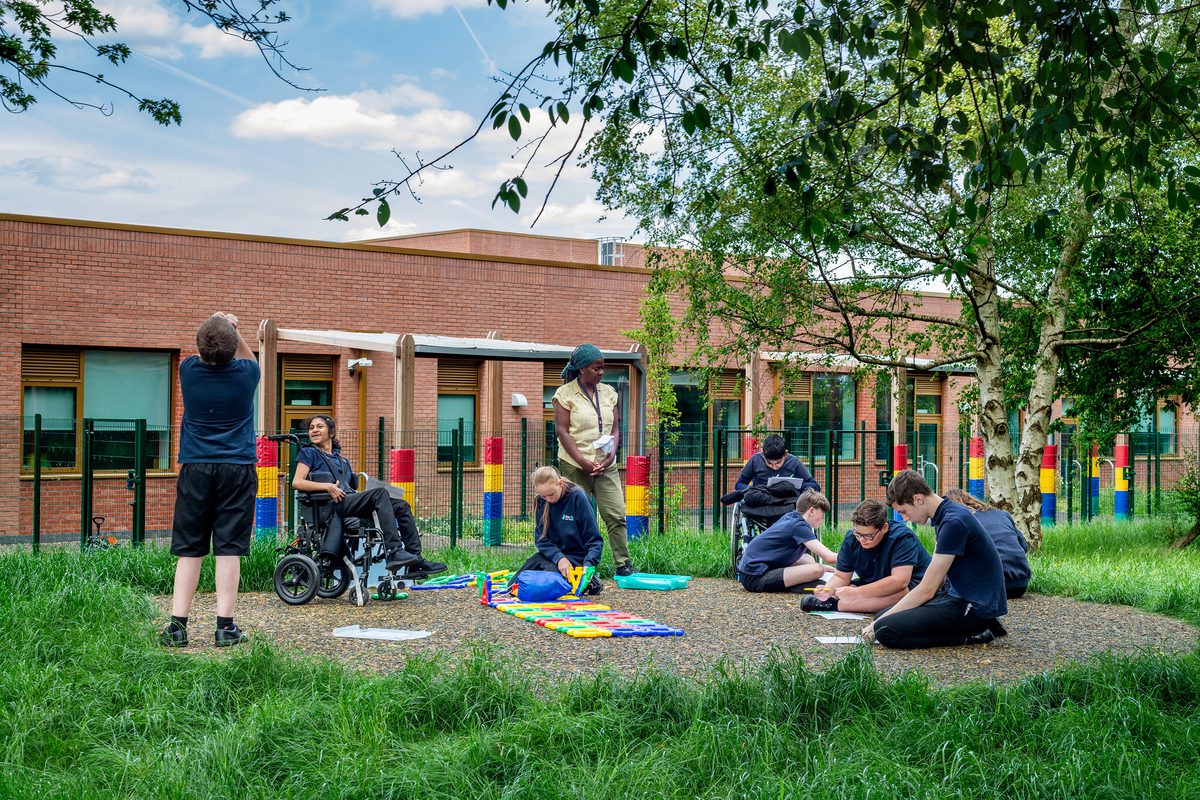
The school was co-created through deep engagement with the Trust and a wide group of stakeholders including staff, families, therapists and the students themselves. A primarily single-storey layout supports intuitive wayfinding and minimises the anxiety of complex transitions.
Sensory design principles run throughout: low-stimulus colour palettes, zoned wayfinding, acoustically sensitive materials and carefully controlled lighting work together to reduce stress and promote focus. Flexible classrooms open directly onto secure external spaces, so that outdoor learning, movement breaks and sensory regulation are embedded into the daily rhythm of school life and not treated as afterthoughts.
The landscape is not peripheral to the scheme; it is central to it. A courtyard acts as the school’s social and sensory heart, while horticulture zones, breakout gardens and quiet pathways support emotional regulation, independence and vocational learning. These are spaces designed to help young people build the skills and confidence they will need beyond school.
The result is a building that doesn’t just accommodate difference. It expects it and it quietly, consistently tells every student who walks through its doors that they belong here, and that the world beyond these walls is within their reach.
Psychological safety for everyone
Something that came through strongly in our panel discussion was the importance of the environment not just for children, but for the staff who support them. Teachers and teaching assistants working with children with complex needs carry significant emotional weight. The spaces they work in either help them carry that weight well, or they don’t.
Good SEND design creates conditions for reflection, quiet spaces where staff can decompress, prepare and think. It reinforces collaborative cultures through shared areas that encourage joint working rather than isolated practice. And it communicates values clearly: a school that has invested thoughtfully in its SEND spaces is telling its staff that this work matters, that it is valued, that it is central - not peripheral - to the school’s identity.
This thinking connects directly to the trauma-informed design principles we explored in our white paper, developed in partnership with the University of Salford. Drawing on our work at Thrive Health and Wellbeing Centre, one of the UK’s first trauma-informed buildings, we developed a set of practical, evidence-informed principles that translate care and emotional safety into tangible design decisions.
Sensory balance, acoustic comfort, intuitive wayfinding, natural light and colour, biophilic elements, these aren’t luxuries. They are the building blocks of environments where people can genuinely thrive.
You can read more about that work and download the white paper here
 Thrive Health and Wellbeing Centre
The moment the white paper arrived
A few days after the conference, the government published its white paper, Every Child Achieving and Thriving. Reading it, I felt a strong sense of recognition. So much of what we had been discussing on that panel such as the need for inclusive mainstream environments, the importance of early, flexible support, the ambition to move children from sidelined to included is included in the paper.
The headlines are significant. There is £3.7 billion committed to create over 60,000 specialist places, including inclusion bases in mainstream schools. The £1.6 billion Inclusive Mainstream Fund will give schools direct responsibility for funding SEND support. A new legal requirement for Individual Support Plans (ISPs) will mean that every child with identified SEND has a personalised, documented framework of provision. And the £1.8 billion ‘Experts at Hand’ service will bring speech and language therapists and educational psychologists directly into schools.
This is the most substantial investment in mainstream SEND provision in a generation. And much of it will need to be delivered through the built environment, through the careful refurbishment and adaptation of existing school estates. That is precisely the challenge we presented at the conference, using Star King Solomon Academy as our lens.
The white paper’s ambition to ensure that ‘every secondary school will have an inclusion base’ is bold. Delivering it across constrained, live school sites - balancing safeguarding, circulation, flexible use, phased construction and varied funding streams - is the practical reality that schools and their design teams will face. The co-design approach, the early stakeholder engagement, the willingness to review the whole masterplan rather than just add a room here and there, these are the things that make the difference between a solution that works and one that merely exists.
What comes next
I left the conference encouraged. The conversation between designers, educators and policymakers is genuinely moving forward. The government’s ambition, backed by real investment, creates an opportunity that we should seize with purpose and care.
But ambition only becomes reality in the detail. In the brief. In the relationship between a design team and a school community. In the decision to put a reflection room next to a classroom, to celebrate an entrance, to design a drop-off zone that eases transitions rather than creates anxiety.
Those decisions shape learner identities. They build psychological safety. They teach values - silently, every single day.
That, for me, is what designing for belonging looks like in practice. And it’s why this work matters so much.
To find out more about our work in SEND design, get in touch
Frequently asked questions
A well-designed SEND school environment does more than provide practical accessibility features like ramps or sensory rooms. It actively shapes how a child feels about themselves and whether they belong. The built environment can reduce anxiety, support emotional regulation, promote independence, and improve learning readiness through inclusive design, clear wayfinding, sensory balance, and flexible spaces that adapt to different needs (including ASC, SLD and PMLD). In short, good SEND design communicates dignity, safety and high expectations, every day.
“Space as a silent teacher” describes how school buildings communicate messages, often unintentionally, about values, inclusion, and whose needs matter. If SEND provision is hidden away, accessed through separate entrances or confusing corridors, the building signals separation and “otherness.” In contrast, inclusive mainstream environments embed SEND support into the heart of the school, using design to normalise difference, support agency, and provide choices for movement, sensory regulation, and learning. This is a core principle of designing for belonging rather than simply meeting minimum compliance.
The most effective SEND-friendly design features tend to reduce sensory overload while improving clarity and comfort. This can include intuitive layouts that make wayfinding easier and reduce transition anxiety, low-stimulus colour palettes, acoustically considered materials, lighting that is carefully controlled to avoid glare or flicker, and flexible learning spaces that allow pupils to regulate, move and learn in different ways. Designs that connect classrooms directly to secure outdoor space also help embed movement breaks and sensory regulation into the normal school day, rather than treating them as an afterthought, and landscapes designed as part of provision can further support emotional regulation and independence.
The government’s SEND white paper, Every Child Achieving and Thriving, sets out major investment and policy changes that will need to be delivered through the school estate, particularly by refurbishing and adapting existing buildings. With funding for specialist places and inclusion bases, direct responsibility for SEND support through the Inclusive Mainstream Fund, new Individual Support Plans (ISPs), and increased in-school access to specialist expertise, schools will need practical, deliverable design strategies for constrained and live sites. Achieving the ambition for inclusion bases in every secondary school will depend on early co-design, stakeholder engagement, safeguarding and circulation planning, and phasing that works around day-to-day school operations, rather than simply adding extra rooms without addressing how the whole environment functions.
Share on
Related Articles

Thought Leadership
Net zero and the future learning estate: Embedding GenZero principles through CF25 delivery
We explore how sustainable school design, CF25 delivery and GenZero principles are transforming England's learning estate for net zero carbon.
Date: 19 Feb 26

by AHR

Thought Leadership
Sustainable Communities for Learning: Building Wales’s next generation of schools
Gary Overton discusses how Wales’s Sustainable Communities for Learning programme is transforming education through long-term investment in net zero, inclusive and community-focused schools.
Date: 17 Feb 26

by Gary Overton
Director, Architecture

Project News
GenZero and nature-based design in practice: Reflections from Education Estates 2025
Imran Kassim has the pleasure of speaking at the Education Estates Conference, sharing insights from our work on Wellfield Academy in Leyland, one of the UK’s first GenZero secondary schools.
Date: 19 Oct 25
by Imran Kassim
Director, Architecture

Practice News
Sharing our insights on how we have shaped inclusive learning environments
Our Director, Gary Overton, alongside Gladys Marr and Sean McKeown, is presenting at the Education Estates SEND Conference, showcasing our Silverwood SEND School project.
Date: 6 Feb 25