Thought Leadership
Designing the net zero NHS: From retrofit to new build

by Gareth Banks
Director, Architecture

With the NHS Net Zero Building Standard now being applied to live hospital projects, the question is no longer whether net zero healthcare is achievable, but how it can be delivered at scale while staying clinically safe, commercially viable and operationally resilient.
We see net zero carbon succeed when it is treated as a core design and estates strategy from day one – not an overlay applied late in the process. That applies whether you are delivering a major new-build hospital, upgrading a community facility, or retrofitting live, occupied estate to tackle backlog, carbon and patient flow in one move.
Beyond targets: net zero that works in real clinical environments
In the context of healthcare, net zero carbon standards only have meaning if they are practically achievable for the highly serviced buildings which are commonly found in clinical settings, and operate day and night, all year round. The Countess of Chester Hospital’s Women and Children’s Building demonstrates net zero carbon can indeed be achieved within realistic budgets.
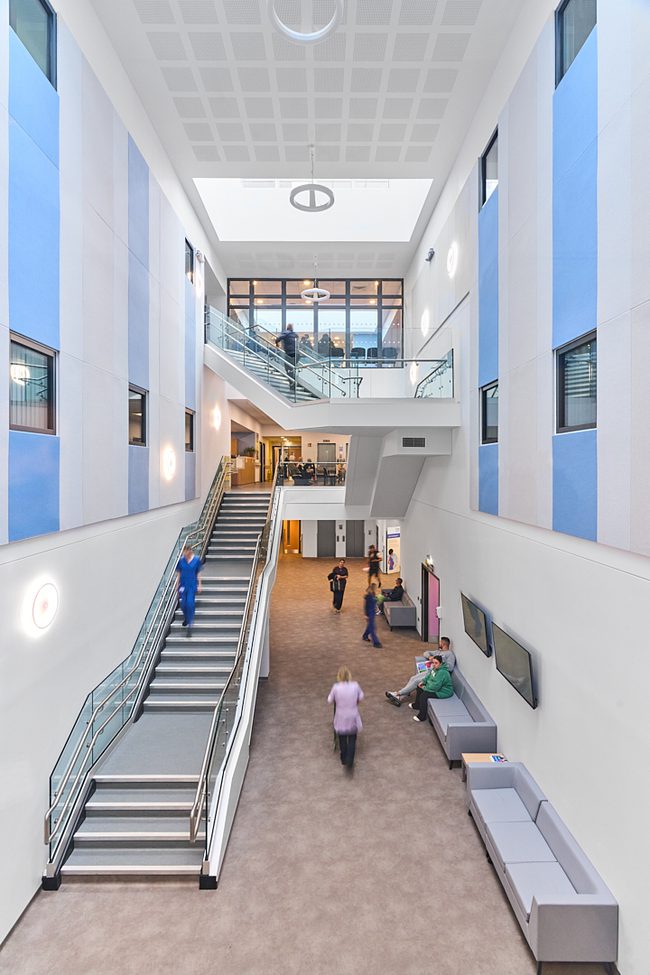
This building is the first project in England to be approved under the NHS Net Zero Building Standard, achieving the net zero target in operation, and bringing maternity, neonatal, paediatric and outpatient services into a 12,210 m² fully electric facility designed around staff support and patient wellbeing.
Crucially, the target has been met without compromising clinical performance, and achieving tangible improvements in the clinical environment for staff, patient and visitors.
The women and children's building replaces a maternity facility constructed using RAAC.
Our design prioritises safe, calm, family-centred care, with the fabric-first and systems approach supporting comfort and lower energy demand in day-to-day use.
Net zero carbon is not just for new-build
Flagship new-build projects matter because they set the benchmark. But the NHS will not decarbonise through new build alone. Most of the estate that will shape 2050 emissions already exists. For many trusts and ICBs, the carbon challenge is fundamentally a retrofit and repurposing challenge – delivered in complex, occupied settings, with limited decant options and real clinical risk.
Our Retrofit Toolkit is designed for this reality. It supports estate-wide decision-making by testing intervention scenarios and helping teams compare options through the lens that boards care about:
- Capital cost and phasing
- Operational energy reduction and running costs
- Embodied carbon and whole-life impact
- Payback periods and net present value
- Buildability and clinical disruption risk.
Of course retrofit is not always the right solution, but using evidence generated by our toolkit, we can prioritise investment, avoid stranded assets, and align decarbonisation with clinical strategy, backlog maintenance programmes and capital gateways through a data driven process.
Decarbonisation as a lifecycle strategy
For estates teams under operational and financial pressure, net zero must be a lifecycle strategy that connects condition data, masterplanning, funding bids, delivery and long-term asset management.
That is why we bring architecture and building consultancy together. The combination allows a coherent pathway from surveys and modelling to deliverable design, procurement and performance in use – so projected benefits do not evaporate after handover.
In practice, this means:
- Triaging estates and prioritising investment where carbon and clinical risk are highest
- Aligning new hospital and community projects to the NHS Net Zero Building Standard so they act as future-ready anchors in the wider estate
- Embedding net zero into briefs, design decisions and procurement routes in ways that are achievable and commercially grounded.
Designing an estate that works for people and the planet
Net zero is not an abstract target for the NHS. It touches patient safety, workforce wellbeing, operational resilience and long-term financial sustainability. Projects like the Countess of Chester Women and Children’s Building show what is possible when sustainability is embedded from the start.
The next step is scaling that thinking across the wider estate through data-led retrofit, careful prioritisation and delivery approaches that protect services while improving performance.
Turning net zero ambition into deliverable estates strategies
Achieving net zero across the NHS estate is no longer a future aspiration. It is a live challenge that touches patient safety and comfort, workforce wellbeing, operational resilience and long-term financial sustainability.
We work with NHS Trusts, Health Boards, Integrated Care Boards and public sector partners across the UK to translate net zero policy into practical, deliverable estate strategies – from portfolio-wide retrofit planning to future-ready new build. Our combined architecture and building consultancy teams support clients from early feasibility and business case development through design, delivery and performance in use.
Whether you are just starting on your Net zero journey or reviewing your current net zero pathway, prioritising investment across existing estate, or planning new healthcare facilities that must meet the NHS Net Zero Building Standard, we would welcome a conversation
Posted on:
Apr 7th 2026
Topics:
Share on
Related Articles

Thought Leadership
Re-engaging staff, reimagining space: Why the NHS Workforce Plan begins with better places to work
Discover how we are supporting the NHS to reimagine workplaces that boost wellbeing, retention and sustainability.
Date: 28 Nov 25
by Gareth Banks
Director, Architecture

Awards
Celebrating our Net Zero Architect of the Year win
We’re proud to have been named Net Zero Architect of the Year at this year’s Building Design Architect of the Year Awards, a reflection of our commitment to sustainability and design excellence.
Date: 26 Oct 25

by AHR

Podcast
How are evolving clinical needs impacting the future of maternity services?
Guest Speakers: Gareth Banks, Victoria Shepherdson and Sandra Reading.
Date: 23 Sept 25
Hosted by Gareth Banks
Director, Architecture

Podcast
How do you shape a future-ready healthcare space that’s truly patient-focused?
Guest Speakers: Victoria Shepherdson, Gareth Banks and Ewan Forsyth
Date: 7 Jul 25